A dream where your car’s brakes don’t work is one of the most common anxiety dreams people report. You’re pressing the pedal and nothing happens, or the car slows but won’t stop. It feels urgent and real. This dream usually isn’t about cars at all—it’s about a situation in your waking life where you feel powerless to slow down or stop something that matters to you.
The basic setup: you see the problem but can’t fix it
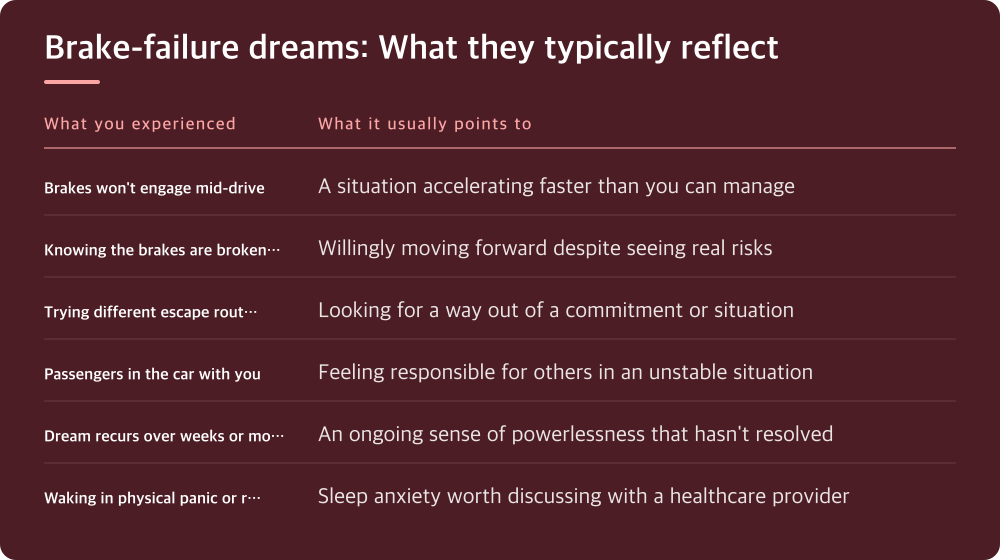
In a failing-brake dream, the core experience is usually the same: awareness without control. You notice the brakes aren’t working—that’s the crucial detail. You’re not asleep at the wheel. You’re not unaware. You feel the pedal go soft, or you hear the absence of that normal resistance, or the car keeps rolling despite your effort. That gap between knowing something is wrong and being unable to stop it is where the dream’s meaning lives.
The specific moment matters a lot. Some people dream they realize the brakes are gone only after they’re already driving fast. Others know before they start the car but drive anyway. That choice—or lack of choice—changes what the dream might be pointing to. If you climbed in knowing the brakes were gone, the dream might be about willingly moving forward in a situation you know is risky. If you discover the problem mid-drive, it’s closer to feeling blindsided by a loss of control you didn’t anticipate.
What you do next also shifts the reading. Some dreamers pump the brake pedal harder, as if effort alone might fix it. Others look for an escape route—a ditch, an open field, a ramp. Some freeze. Some try to downshift or use the emergency brake. Each of those responses is worth noticing when you wake up. The action you take in the dream often mirrors how you actually respond to chaos in real life: Do you push harder? Do you look for an exit? Do you go numb?
One common variation is the dream where other people are in the car with you. A passenger screaming, or a child in the back seat, or your partner sitting quietly while you panic—that changes everything. It moves the dream from being about your own sense of control to being about responsibility for others. You’re not just worried about yourself going off the road; you’re terrified of what might happen to them. That’s often closer to the bone.
Powerlessness in your work or a major commitment
Failing-brake dreams show up most often for people in situations where they’re supposed to maintain control but feel like they’re losing it. A common trigger is a job where you’re managing something large—a project, a team, a deadline, a decision—and you can sense it slipping. You’re trying to steer it in the right direction, but events are moving faster than your ability to influence them. The dream is your mind’s way of saying: I know this is careening toward trouble, and I don’t know how to stop it.
The person who dreams this during a troubled relationship often describes the dream as matching what they feel watching the relationship deteriorate. They see problems developing. They try to address them. But their partner won’t engage, or the core issue is too big, or communication keeps breaking down. So the relationship keeps rolling forward, picking up speed, and no amount of effort on the dreamer’s part makes it slow. The dream captures that exact sensation: I can see where this is heading and I’m powerless to change the trajectory.
Financial situations trigger these dreams too. Someone taking on more debt than they’re comfortable with, or watching their savings deplete faster than expected, or committed to payments they now regret—the brake-failure dream shows up. The vehicle is committed to going forward. You’re in it. You can see the cliff or the wall or the dense traffic ahead. But you can’t make it stop. That dream is not predicting a specific disaster; it’s reflecting the actual sensation of feeling locked into a path you didn’t choose and can’t reverse.
Illness or health decline can produce this dream as well. You notice something wrong with your body. You try to slow it down—rest, medication, lifestyle changes. But the problem keeps advancing. The dream of useless brakes becomes a metaphor for the specific powerlessness of a body not responding the way you want it to. If a dream like this is tied to ongoing health distress or anxiety about your physical condition, that’s worth talking through with a doctor or therapist who can help you separate the dream content from the real worry beneath it.
Speed itself as the real threat
Sometimes the specific detail isn’t that the brakes are broken. It’s that you’re going too fast. You’re in a car that won’t slow down because you can’t take your foot off the accelerator, or because the speed is somehow self-propelled, or because there’s no brake pedal at all. The dream is less about mechanical failure and more about momentum. You’re committed to moving forward at a pace that frightens you, and you don’t see how to downshift.
This version of the dream often shows up for people in a period of rapid change—a career acceleration that feels exciting but also terrifying, a relationship moving faster than feels safe, or life circumstances forcing you to adult in ways you’re not ready for. The dream isn’t saying these changes are bad. It’s saying: I’m not sure I can keep up with the speed this is happening at. I don’t know if I can handle what comes next at this velocity.
The scenery in the dream matters here. Are you driving through a familiar neighborhood, or a highway, or a narrow mountain pass? A familiar setting with normal-speed dangers feels different from a narrow pass where any speed is too fast. The dream is showing you not just that you’re moving too fast, but whether you’re on a road where speed is ever safe. If you’re flying down a residential street where everyone should be going slowly, the dream is saying: This isn’t the right pace for where I am. If you’re on a highway designed for speed but you’re terrified anyway, the dream might be more about your own discomfort with not being in total control.
The people around you in the dream—or the absence of them—also matters. If you’re alone in the car at high speed, that’s a different reading than if you’re responsible for passengers. Alone, it might be about your own anxiety about losing control of your life or career. With passengers, it’s about the weight of responsibility. You can’t just let the car crash; there are people depending on you to keep them safe, and you’re not sure you can.
What the dream reveals about how you handle actual pressure
The failing-brake dream is often less about predicting what will happen and more about showing you how you typically respond when you feel powerless. If your dream-self panics, that’s one kind of information. If you stay oddly calm, that’s different. If you try to solve it alone, versus calling for help or accepting help from someone else in the car, that tells you something about your actual response to crisis.
Pay attention to whether the dream repeats. A recurring brake-failure dream often signals that you’re facing an ongoing situation where you feel stuck or powerless, and your waking self hasn’t found a way to address it yet. The dream keeps showing up because the core situation hasn’t changed. That’s not a prediction of doom; it’s your mind saying: This thing that’s making you feel out of control is still here, and you haven’t resolved it. What would it take to actually address it, rather than just white-knuckling through?
Some people report that brake-failure dreams stop once they make a significant change in their waking life. Someone quits a job they felt trapped in, or ends a relationship they knew was deteriorating, or takes action to address a health concern. The moment they regain some actual agency, the dream stops. That’s not because the dream predicted anything. It’s because the dream was reflecting a real state of powerlessness, and once that state changes, the dream’s job is done.
The useful question to ask yourself after this dream isn’t “What will happen?” It’s “Where in my actual life do I feel like this right now? Where am I accelerating beyond my control, or trying to slow something down that won’t stop?” Once you identify that, you can ask the follow-up: What is one thing I could actually do to regain some control, or to accept the lack of control more consciously? Sometimes the answer is to make a change. Sometimes it’s to adjust your expectations of how much control you can actually have.
Physical anxiety versus psychological meaning
If you wake from this dream in a panic, with a racing heart or the sensation of falling, that’s worth noting separately from what the dream means. Some brake-failure dreams are wrapped in physical anxiety symptoms—your body is in a state of alarm, and the dream is built from that alarm. If this happens frequently, or if you’re waking in distress most nights, that’s worth talking to a doctor about. Sleep disruption and recurring nightmares can be a sign of sleep anxiety, stress, or other conditions that a medical professional can actually help with.
It’s possible for a dream to have both a psychological meaning and a physical cause. You might be experiencing real anxiety (rooted in a job situation or a relationship problem), and that anxiety is also manifesting as poor sleep and vivid, intense dreams. The dream is both real (reflecting something true about your situation) and also a symptom (telling you that your nervous system is in overdrive). Both things are true at once.
The standard advice for managing anxiety dreams is worth trying: Keep a consistent sleep schedule. Exercise earlier in the day, not right before bed. Avoid heavy meals and alcohol near bedtime. Keep the bedroom cool and dark. These steps don’t remove the dream’s psychological meaning, but they do reduce the likelihood that your body is primed to wake in a panic. If you’re already managing those basics and the dreams persist, that’s the conversation to have with a sleep specialist or a doctor, not just an interpretation guide.
Notice too whether the dream feels urgent and real, or more distant and symbolic. Some people dream that brakes fail and feel genuine terror in the dream. Others know it’s a dream while it’s happening, or wake feeling thoughtful rather than panicked. That difference in emotional intensity doesn’t change what the dream might mean, but it does change whether the dream itself is a problem for your sleep quality. A powerful, disturbing dream is worth examining. A disturbing dream that’s also waking you in a state of panic is worth getting checked out.
What to do after a brake-failure dream: start where you have control
The first step is to identify what in your actual life feels like the failing brakes. Don’t overthink it. Usually the connection is fairly direct. Something in your life is moving forward at a pace you’re not comfortable with, or you’re trying to slow something down and it won’t stop, or you’re locked into a commitment you’re second-guessing. That thing. Once you name it, you’ve already moved from the dream’s powerlessness to actual clarity.
The second step is honest: What control do you actually have in this situation? Often the dream exaggerates the powerlessness. You might feel locked in, but there are usually at least a few levers you can pull. You might quit, or end something, or have a difficult conversation, or set a boundary, or ask for help, or change how you’re showing up to the situation. The dream says you’re powerless. Reality usually offers options, even if they’re uncomfortable. What’s one option you’ve been avoiding?
If you don’t have as much control as you’d like—and sometimes you don’t—the useful move is to consciously accept that and adjust your expectations. If you can’t stop a situation, can you at least make peace with where it’s going? Can you stop fighting it? Can you prepare differently? Can you get support from other people to manage the impact? The dream of failing brakes, once interpreted, is an invitation to either regain control or stop exhausting yourself trying to control things you can’t. Both are better than the liminal space of the dream: knowing there’s a problem and feeling completely powerless.
One concrete action today: Write down what the brake-failure dream felt like, and next to it, write one sentence: “In my actual life, this feels like ___.” Fill in that blank honestly. That’s your starting point. From there, you can decide whether you’re in a situation that needs changing, a situation where you need to accept limited control, or a situation where your anxiety is outsized relative to the actual risk. The dream is information. What you do with it is up to you.
The dream isn’t a prediction; it’s a signal about now
A crucial point that often gets lost: This dream does not predict that your car will fail, or that your relationship will end, or that you’ll lose your job, or that your health will get worse. The dream is not a prophecy. It’s a reflection of what you’re currently feeling and experiencing. It’s your mind processing an actual sense of powerlessness or loss of control in real time.
Lots of people have this dream once and then never again. That’s usually because they had a stressful period, the dream reflected that stress, and then the stress resolved or they adapted to it. If the dream is recurring, it’s worth asking: Is this situation actually unresolved? Am I still in a state of powerlessness about something? Is there an action I could take that I keep putting off? The recurring dream is not destiny; it’s persistence. It’s your mind saying: We’re still here, this is still bothering you, what are you going to do?
The goal isn’t to stop having the dream through sheer willpower or interpretation alone. The goal is to understand what the dream is pointing to, and then to address that thing in your waking life in whatever way makes sense for your situation. Sometimes that’s taking concrete action. Sometimes it’s accepting something you can’t change and finding peace with that. Sometimes it’s reducing stress, getting support, or talking to a professional. The dream has done its job once it makes you think about what’s actually going on underneath it.
Start here: One thing to try today
If you’ve had this dream, do this: Spend ten minutes writing about what felt out of control in the dream. Don’t interpret it yet. Just describe what you experienced: the feeling of pressing the pedal, what you saw, what you did, how it ended. Write it like you’re explaining it to someone else, including details about your emotional state. That act of describing pulls the dream out of the vague-anxiety category and into something concrete you can think about.
Then ask yourself: Where do I feel this way right now? What situation in my actual life matches this sense of powerlessness or lost control? It might be obvious. It might take a minute. But usually the connection is there. Once you’ve made that connection, you have something to work with. You can decide whether that situation needs you to take action, or accept what you can’t control, or get help, or change how you’re relating to it. That’s where the dream’s real value lives.
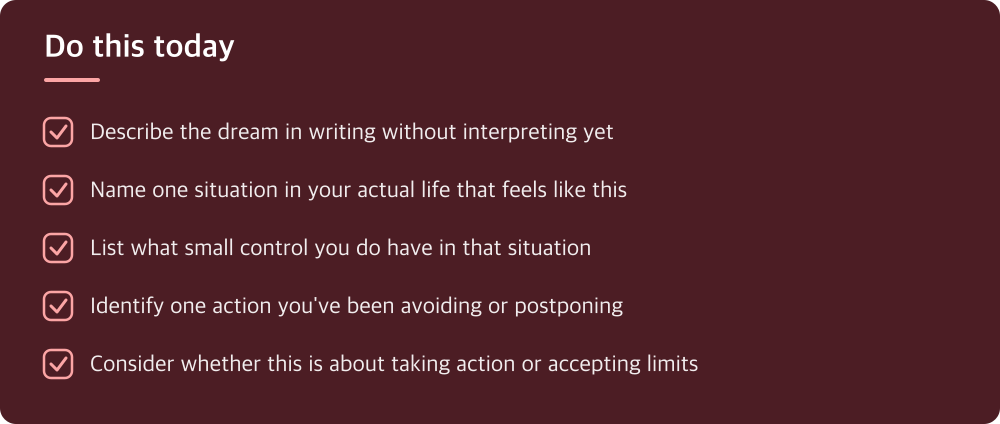
Do this today
- Describe the dream in writing without interpreting yet
- Name one situation in your actual life that feels like this
- List what small control you do have in that situation
- Identify one action you’ve been avoiding or postponing
- Consider whether this is about taking action or accepting limits
※ This is informational and not a recommendation of any specific product or company.
1 thought on “Dreams of Failing Car Brakes: What Loss of Control Actually Means”