
A dream that comes back night after night feels like it means something urgent. But panic usually blocks understanding. The practical move is to treat your recurring dream like a message written in a code you can actually break—not by guessing what it predicts, but by noticing what details repeat, what shifts, and what your sleeping mind keeps trying to show you.
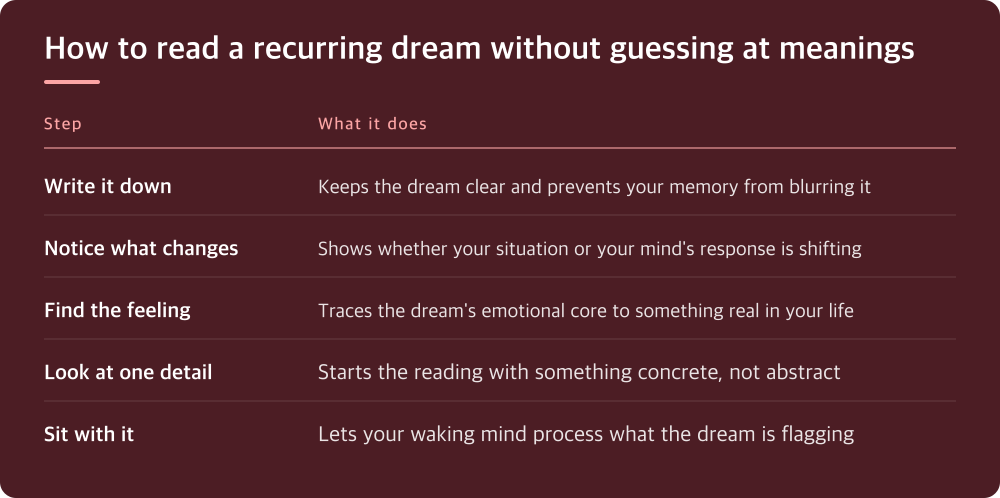
Recurring dreams are your brain flagging something, not predicting doom
When the same dream shows up multiple times in a row or over weeks and months, your mind is doing what it does best: pattern-matching. Something in your waking life has triggered a loop in your sleep, and the dream keeps cycling because the loop hasn’t resolved. This doesn’t mean the dream is prophetic or that you’re broken. It means your brain noticed a pattern that your waking self might have overlooked or pushed aside. The dream is insistent precisely because it’s trying to get your attention about something real.
The key shift in perspective is this: stop asking “What does this mean about my future?” and start asking “What about my current situation does this dream reflect?” Someone who dreams repeatedly about missing a flight isn’t necessarily going to miss a flight. But they might be carrying real anxiety about timing, about not being ready, about losing control of a deadline. The dream isn’t a prediction—it’s a spotlight. Your sleeping mind is saying, “This thing matters to you, and right now you’re stressed about it.”
What makes a dream recurring is usually not that the dream itself is rare or mysterious. It’s that the underlying concern is active and unresolved. The dream will often fade once you address what triggered it, or once you’ve processed the feeling enough that your brain no longer needs to flag it. This is why the same dream can haunt you for weeks and then suddenly stop without you doing anything dramatic. Your situation shifted, or your relationship to it changed, and the alert went quiet.
The mistake most people make is treating the dream as separate from their life. They think: “I had this weird dream again. I wonder what that means about destiny.” But the dream is not separate. It’s an echo of something in your life right now that your conscious mind hasn’t fully acknowledged or worked through. That’s why reading a recurring dream starts with looking at your waking world, not at dream dictionaries.
Write down what actually happens in the dream, not what you think it means
The moment you notice a dream is recurring, grab a pen and write it down before you forget it. Not an interpretation. Not a one-liner like “I dreamed about my ex again.” The actual sequence: what you saw, what you felt, what you tried to do, what happened to you. This matters because your memory of a dream softens and reshapes over time, and by the tenth replay in your mind, you’ve already started editing it into something simpler than it was.
Let’s say you keep dreaming about being in your childhood home and water is flooding in through the walls. Write: I was in the living room of the house I grew up in. The walls were light blue like they actually were when I was a child. Water was coming through the drywall on the east side. I tried to put towels down but couldn’t move fast enough. I felt panic and also a strange calm underneath it, like I knew I should do something but couldn’t quite move. The water got to my knees and I woke up. Notice all of that—the specific room, the blue walls, the east side, the mix of panic and calm, the paralysis. Each detail might connect to something in your life.
Now read what you wrote and ask: Which of these details are true or relevant right now? You grew up in that house. Were you happy there? Stressed? Safe? Do you associate that place with a particular person or period? The water flooding in—is there something in your current life that feels like it’s coming at you from outside your control? Is there an area of your life (the east side, the specific wall) where you feel defensive or exposed? Are you trying to handle something but feeling like you’re in slow motion?
The point of this exercise isn’t to find one perfect meaning. It’s to notice which details of the dream connect to real details in your waking life. The dream is using the language of your own history and your current emotional state. When you write down the dream exactly, you’re making it harder for your brain to blur it into a generic nightmare shape. You’re seeing what your brain actually constructed.
Look for what changes from dream to dream, not just what repeats
Most people notice the repetition—the same setting, the same threat, the same general feeling of dread. But the variation is often more useful. If you’ve had this dream five times, what’s different between dream one and dream five? Is the threat closer or further away? Are you more in control or less? Do you have different resources or tools? Can you run away or are your legs heavier each time? These shifts are clues about how your waking situation is actually changing.
Take someone who repeatedly dreams of being chased through a building. First dream: they’re in a modern office and they’re running fast, pulling away. Third dream: same building, but slower. They’re exhausted. Fifth dream: they know the building now, they’re taking shortcuts, the person chasing them is blurry, less distinct. That progression tells a story. It suggests that whatever threat triggered the first dream is becoming more familiar and less acute—or that the dreamer’s relationship to it is shifting from panic to strategy. That matters. It says the dream is responding to real change.
Or another pattern: someone dreams of being late to an exam. First time: regular classroom, can’t find the room. Second time: finds the room but hasn’t studied. Third time: seated at the desk but the words on the test are blurry. The threat is staying the same (being unprepared), but the obstacle is shifting (location, preparation, perception). This suggests the real-life worry is evolving or deepening. It’s not just generalized test anxiety—the dreamer is now grappling with a specific new aspect of it, or the anxiety is hitting a different nerve.
Tracking these shifts requires you to actually write down or remember multiple versions of the dream. It’s tedious, but it works. By noticing whether the dream is getting worse, better, or just sideways different, you can see whether your waking situation is stabilizing or intensifying. The dream is a live signal, not a fixed message. It changes as you change.
Connect the dream’s emotional tone to something happening right now
The feeling you have in a recurring dream often matters more than the plot. Someone might dream about drowning, or missing an appointment, or showing up unprepared—but the emotional core is the same: powerlessness, unreadiness, exposure. When you read a recurring dream, ask what emotion is at the center and what’s genuinely making you feel that way in your current life.
Consider someone who dreams they’re at a party and they don’t know anyone. They’re standing alone, everyone else is talking and having fun, and they don’t belong. The dream itself is mild—no violence, no disaster. But the feeling is acute: loneliness, inadequacy, being outside. Now map that to their current life. Are they new to a job? Have they moved? Have their friends shifted in some way? Have they been spending more time alone by choice or circumstance? The dream isn’t predicting that they’ll be lonely. It’s reflecting that loneliness is active in their life right now, and their mind is processing it in sleep.
Another example: someone dreams they’re trying to call for help but their voice won’t come. The threat varies—sometimes they’re being threatened, sometimes there’s a fire, sometimes it’s just an emergency. But the core is voicelessness. In their waking life, they might be in a situation where they feel they can’t speak up: a relationship where they don’t feel heard, a workplace where they’re intimidated, a family dynamic where their opinion doesn’t matter. The dream is a nightly rehearsal of the feeling of powerlessness, and it won’t stop until they either address the situation or process the feeling of being unheard.
The emotional tone is often the fastest way to narrow down what your mind is flagging. Write down how you felt in the dream—not just scared or sad, but specifically: Was it helplessness? Urgency? Shame? Betrayal? Inadequacy? Then ask yourself: Where do I feel that exact way right now? The dream is usually not more mysterious than your own emotional life. It’s your mind’s way of saying, “This feeling is important and you’re not dealing with it enough when you’re awake.”
If the dream is tied to trauma or causing real distress, talk to a professional
There’s a difference between a recurring dream that’s annoying or confusing and one that’s genuinely upsetting, causing sleep problems, or connected to past trauma. If a dream is making it hard for you to sleep, if it’s tied to something painful that happened to you, or if the distress it causes doesn’t ease when you think through it, that’s the moment to bring it to someone qualified to help.
A doctor or licensed therapist can help you in ways this article cannot. They can assess whether the dream is connected to a sleep disorder, whether it’s part of a larger pattern of distress, or whether it’s something that needs specialized help like trauma-focused therapy. Some recurring dreams are part of conditions that have actual treatment pathways. Some are signs that you need support beyond self-reflection. That’s not failure. That’s good judgment.
What you can do on your own is notice. If you’re having trouble sleeping, if the dream is waking you in panic, if it’s tied to something that happened to you that still hurts, make that your signal to reach out. Your own reading of the dream is a starting point, not a substitute for professional care. The goal is to understand yourself better, and sometimes understanding means knowing when to ask for help.
Start with the clearest details to unlock what the dream is actually about
When you sit down to read a recurring dream, don’t start with the big picture. Start with the clearest, most concrete detail you remember. Not the feeling of threat or the general plot, but one specific thing: a room, a person, an object, a sensation. What’s one thing that always shows up? What do you always notice?
If the dream keeps showing you a specific place—a hallway, a basement, your childhood bedroom, an unfamiliar office—that place is probably a clue. Places in dreams often represent states of mind or areas of your life. But don’t use a dream dictionary. Ask yourself: What does that place mean to you? What happened there? How do you feel about being there? A basement might mean vulnerability or the past to one person and safety or rest to another. The place is only meaningful in relation to your own life and associations.
If a person keeps appearing—someone you know, a stranger, someone you can’t quite see—that person or figure is worth examining. Even if it’s someone you’re not fond of or don’t typically think about. Dreams often put people in front of us to represent something we need to look at. The question isn’t whether the dream is predicting an encounter. It’s whether this person represents something in your life you haven’t resolved—a conflict, a warning, an aspect of yourself you don’t usually acknowledge.
Start with one clear detail, trace it back to your waking life, and let that thread lead you into understanding. You don’t need to decode the whole dream at once. You just need to start with something concrete and ask, “What does this connect to in my current life?” Often, one honest answer to that question opens up everything else. The dream makes sense not when you’ve found the right meaning, but when you’ve found the connection to something true about where you actually are right now.
The work is noticing and sitting with the dream, not forcing a solution
The practical move is not to solve the dream or make it stop. It’s to notice what it’s telling you, acknowledge it, and let that acknowledgment change something. Sometimes that something is small: you realize you’ve been ignoring a real worry, so you name it out loud. Sometimes it’s bigger: you realize you need to have a conversation, make a change, or get help. But the dream itself often quiets down once your waking mind has actually paid attention.
You don’t need to take immediate action on every dream reading. If you dream repeatedly about being unprepared, the solution isn’t necessarily to overhaul your whole life. It might just be to notice that you’re carrying a low-level anxiety about being good enough, and that’s worth acknowledging instead of pushing away. The dream loosens its grip on you once you’ve seen it clearly and said, “Yes, that’s real. That matters.” Your brain stops insisting because it’s finally been heard.
Start this week by writing down your recurring dream as soon as you remember it. Write the actual sequence, the details, the feeling. Don’t rush to interpret it. Just get it on paper while it’s fresh. Then sit with it for a few days. Notice what parts of it connect to your current life. Notice what feeling is at the center. You’re not looking for a diagnosis or a prediction. You’re looking for what your mind is trying to tell you about now.
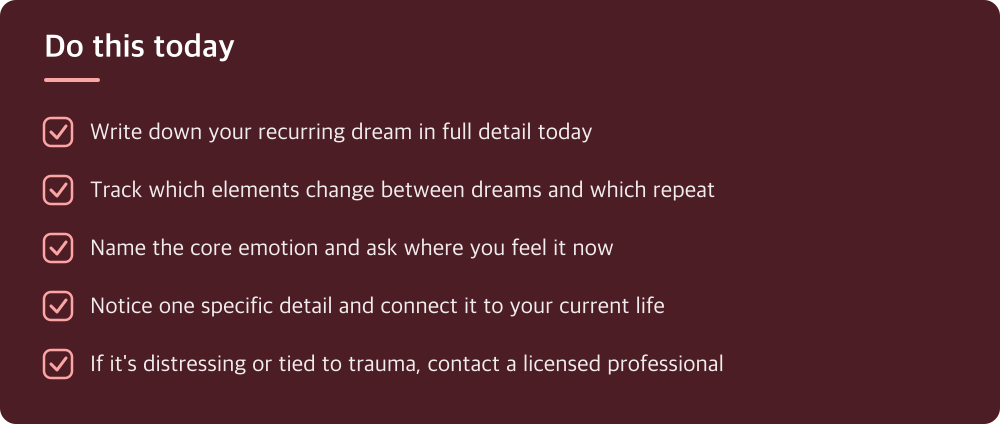
What to do today
If you have a recurring dream, write it down right now—the actual sequence, settings, and feelings, not an interpretation. Keep that paper somewhere you’ll see it. Next time the dream comes, add to what you wrote. Notice what changes and what stays the same. Within a week of actually documenting the dream instead of just replaying it in your head, most people start to see a connection to their waking life. That connection is where the work begins.
Do this today
- Write down your recurring dream in full detail today
- Track which elements change between dreams and which repeat
- Name the core emotion and ask where you feel it now
- Notice one specific detail and connect it to your current life
- If it’s distressing or tied to trauma, contact a licensed professional
※ This is informational and not a recommendation of any specific product or company.
2 thoughts on “How to Read a Recurring Dream Instead of Just Worrying About It”