
You open your mouth to call for help and nothing comes out. Or you’re trying to warn someone and your voice just vanishes. These dreams feel suffocating and urgent—and they stick with you after you wake. Here’s how to read them without panic.
Silence in dreams usually signals a gap between what you want to express and what feels safe to say
When you cannot scream or speak in a dream, the first thing to notice is not the silence itself but the gap it creates. You have something you want to communicate—urgency, fear, a warning, a plea—and the mechanism to do it has stopped working. That gap is where the dream’s meaning lives. The dream isn’t showing you a prediction; it’s showing you a tension that already exists in your waking life. You may be in a situation where you feel your voice doesn’t matter, or where speaking up carries real or imagined consequences. The dream externalizes that tension by literally removing your ability to speak.
Consider a concrete example: a person dreams they’re at work, their manager is making a decision that will affect the team, and they know the decision is flawed. The dreamer opens their mouth to speak up, but no sound comes. They try again, harder, and still nothing. The manager walks away and implements the decision. When the dreamer wakes, they realize they’ve been staying quiet about concerns at work for months—not because they can’t speak, but because they’re afraid of how the manager will react, or whether anyone will listen, or whether it will be held against them later. The dream isn’t predicting that they’ll lose their voice. It’s showing them what the current situation feels like from the inside: a sense of powerlessness disguised as silence.
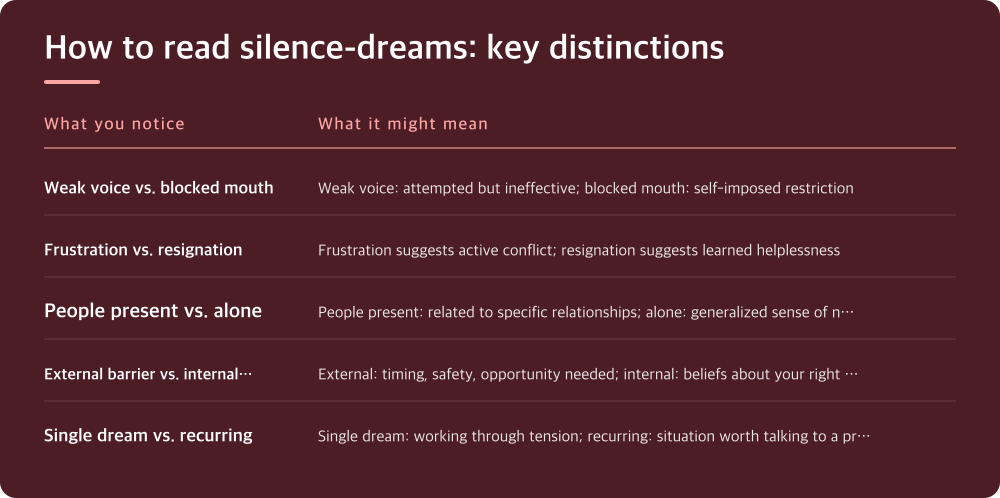
The details matter here. If you’re trying to scream but your voice is weak, that often points to a different sense of the problem than if your mouth won’t open at all. Weak voice might suggest that you believe you’ve tried to speak but haven’t been heard—you’re not being stopped externally, but your words feel ineffectual. Mouth won’t open might point to self-imposed restriction: you’re stopping yourself before you even begin. Neither is a diagnosis or a prediction. Both are mirrors of how the situation feels internally right now.
Pay attention to whether you’re alone when you can’t speak, or whether there are people present who need to hear you. That changes the reading significantly. If you’re trying to call out in an empty space, the dream might be pointing to a generalized sense of not mattering, of your voice being irrelevant whether or not anyone is there to hear it. If there are specific people present—people who would listen if you could make a sound—the dream is likely tied to a particular relationship or situation where you feel unheard or unsafe to speak.
The emotions you feel during the silence often matter more than the silence itself
A dream where you cannot speak is not interesting because of the speech loss. It’s interesting because of what happens to you while that’s occurring. Do you feel frustrated? Panicked? Resigned? Numb? The emotional texture of the dream is often the actual message, and the inability to speak is just the frame that holds it.
Someone might have a dream where they’re in a meeting, they cannot speak, and they feel intense frustration and desperation—they’re straining, they’re desperate to be heard, they wake up with adrenaline still running. That dream points to active conflict: they want to be heard, they believe they should be heard, and they’re running up against something that’s stopping them. For this person, the reading might point to a situation where they need to find a different channel, a different time, or more direct preparation to say what needs to be said. The dream is showing them the cost of not speaking.
Another person might have a dream where they cannot speak and they feel almost detached—they watch their mouth not opening or their voice not emerging and it feels like it doesn’t really matter. They’re not straining. They’re observing. When they wake, there’s sadness rather than urgency. For this person, the dream might be pointing to a longer pattern of disconnection or learned helplessness. They’ve been quiet for so long that they’ve stopped believing their voice would matter anyway. That’s a different reading and often points to a different place to start.
Pay close attention to what changes between the moment you realize you can’t speak and what happens after. Some people dream that they accept the silence and move on. Some people dream of finding other ways to communicate—writing, gesture, drawing attention to something physical. Some people dream of the silence as final and walk away. These variations shift the meaning significantly. A dream where you can’t speak but then write something down suggests you’re resourceful, that you’re exploring alternatives. A dream where you go silent and nothing happens next might suggest a sense of fatigue or surrender around the situation.
Context in the dream—where you are and who needs to hear you—anchors the reading to your waking life
The location and audience in the dream are not random details. They’re often the dream’s way of pointing you toward what situation in your waking life is behind this. If you cannot speak in a crowd, the reading is likely different than if you cannot speak alone with one person. If you’re trying to speak in an office, that’s different than a home, different than a public street.
A common version: someone dreams they’re at a family gathering and they cannot speak. Everyone else is talking, laughing, arguing, and they open their mouth and nothing comes out. They try multiple times. Sometimes in this dream the family doesn’t notice they’re trying. Sometimes they do notice and are waiting, and the dreamer feels pressure but still cannot speak. This dream often mirrors a waking pattern where the person feels either excluded from family dynamics or trapped by them—they don’t get to have a voice, or they’ve learned it’s safer not to try. The specific details distinguish between these: if the family is ignoring the attempt to speak, it points toward exclusion or not mattering. If they’re waiting and watching, it often points toward pressure or expectation.
Another version: someone dreams they’re trying to call for help or warn someone of danger, and they cannot scream. This is often cited as the most frightening version of this dream. When you read this one, notice whether the person you’re trying to warn can hear you even without the sound. Sometimes the dream shows you as voiceless but still able to make yourself understood through gesture or movement. Sometimes the dream shows you as completely unable to get the message across no matter what you try. These are different experiences: the first suggests that you believe you can find a way to communicate if needed; the second suggests a deeper fear that you are fundamentally unable to prevent harm or change a situation. Neither is a prediction. Both are worth noticing.
The spatial relationship between you and the people in the dream also matters. Are they close enough to hear you if you could speak? Far away? Turned away from you? Blocked from view? These small details often point to what the actual barrier feels like in your waking life. If people are present but turned away, the barrier might be attention or interest. If they’re far away or blocked, it might feel like a structural distance—you can’t reach them even if you try. That shapes how you might approach the actual situation in your waking life.
Not every silence-dream points to something you need to say out loud right now
There’s a common assumption that if a dream shows you silenced, it means you’re supposed to go find your voice and speak. Sometimes that’s the right reading. Sometimes it’s not. The dream might be showing you something else: that you need rest, that you’re depleted, that you’re in a situation where silence is actually a form of protection, or that you need to grieve something you’ve already lost.
Pay attention to whether the dream feels like it’s showing you a problem or a solution. Some silence-dreams feel like urgency: you’re desperate to speak, the dream is uncomfortable, you wake up unsettled. Those often do point toward something you’re carrying that wants to be expressed. Other silence-dreams feel more neutral or even gentle—you’re quiet, you’re observing, it doesn’t feel traumatic. Those might not be pointing toward a need to speak. They might be pointing toward a need to listen, or to let something go, or to accept a situation you can’t change.
Consider: someone who is exhausted and depleted might dream of being unable to speak not because they’re silenced but because they’re too tired to try. The dream might be showing them that they need rest and recovery more than they need to process another interaction. Someone in a genuinely unsafe situation might dream of not being able to speak as a form of adaptive silence—their quiet keeps them safe. The dream isn’t a problem to solve; it’s a protective instinct being shown to them. Someone who is processing grief might be quiet in dreams because there’s nothing to say yet, or because words feel inadequate. That’s not silencing; that’s the natural rhythm of processing loss.
Before you assume the dream means you need to find your voice and use it, ask yourself whether the silence in the dream feels like a problem you’re trying to solve or a state you’ve accepted. If you’re straining, panicking, desperate—that often points to something you want or need to express. If you’re quiet but okay, or quiet and observing, it might point toward something else entirely. The dream shows you the experience from the inside; your job is to recognize which part of your waking life this experience mirrors.
If this dream happens repeatedly or leaves you in real distress, check in with what’s actually happening in your life
A single dream where you can’t speak is usually just your mind working through a tension. If this dream happens frequently, or if it leaves you genuinely distressed and unable to settle after waking, that’s worth taking seriously—not as a prediction or message from the universe, but as a signal that something in your waking life deserves attention.
Recurring silence-dreams sometimes point to an ongoing situation where you feel unheard or unsafe to speak. They sometimes point to anxiety or hypervigilance that’s elevated enough to be affecting your sleep and dreams. They sometimes point to past experiences that are still active in your nervous system. If the dream is vivid enough or upsetting enough that it’s interfering with your sleep quality or your day, or if it’s bringing up feelings that linger and don’t settle, that’s information worth taking to a doctor or licensed therapist. They can help you figure out whether this is about a specific waking situation, about anxiety patterns, about trauma, or about something else. This is not something to solve by dream interpretation alone.
There’s also a practical element: if you’re waking up repeatedly distressed, your sleep is being disrupted, and that itself is a problem worth addressing. That might mean talking to your doctor about sleep quality. It might mean working with a therapist on anxiety. It might mean looking at what’s happening in your life that’s activating this response. The dream is real and your distress is real, but the solution is often not in interpreting the dream—it’s in addressing what’s underneath it.
Start with the smallest, most honest description of the gap between what you want to say and what feels possible
If you’ve had this dream and you’re trying to make sense of it, don’t start with grand interpretation. Start with specifics. Write down: In the dream, I wanted to [specific thing]. The barrier was [the silence / my fear / their response / something else]. In my waking life right now, the equivalent might be: I want to say [specific thing] but I’m not because [specific reason]. Notice whether the reason is external (the person won’t listen, it’s not safe, there’s no opportunity) or internal (I’m afraid, I don’t believe it matters, I’m not sure I have the right to speak).
That distinction matters. If the barrier is external, the work might be about timing, preparation, finding the right person or channel, or accepting that you can’t control whether someone listens. If the barrier is internal, the work might be about understanding why you don’t believe you have the right to speak, or why you’re afraid, or what would need to be true for you to feel safe trying. These point toward different actions.
The dream is not a problem to solve by forcing yourself to scream or demanding to be heard. It’s usually pointing toward something that’s already uncomfortable in your waking life. The most useful thing you can do is name it honestly: ‘I’m worried that if I say X, then Y will happen.’ Or ‘I want to tell them Z but I don’t feel like I have the standing to say it.’ Or ‘I know I should speak up but I’m too tired right now.’ Once you’ve named the actual gap, you have something you can work with. You can test whether your fear is accurate. You can build toward saying something. You can decide that now is not the time and that’s okay. You can figure out what would need to change for you to feel safe or capable. The dream showed you the tension. The next step is deciding what to actually do about it in your waking life.
Today: name one situation where you’ve been quiet and notice whether the silence was protective or costly
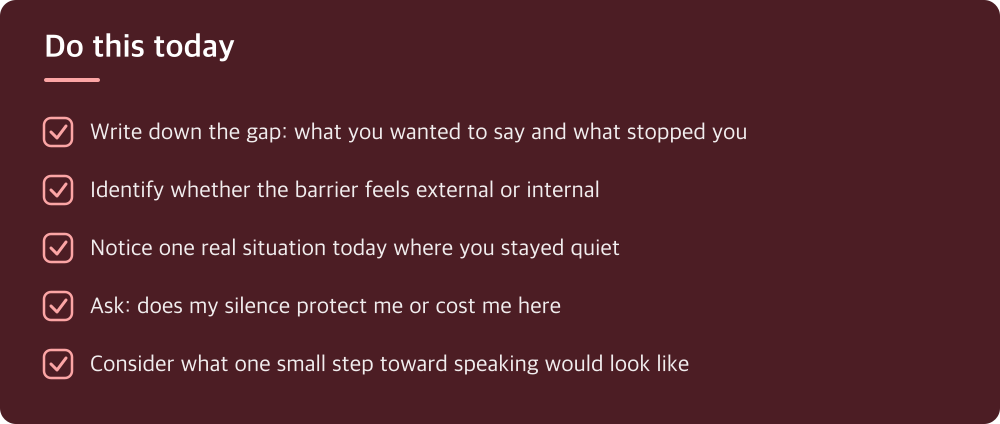
Here’s what you can do with this today: think of one real situation in your waking life where you’ve stayed quiet when you wanted to speak. It doesn’t have to be related to the dream. Just notice it. Ask yourself: in this situation, is my silence protecting me from something real, or is it costing me something I want? Is it both? There’s no right answer—silence is sometimes the right choice and sometimes it isn’t. The point is to notice whether you’ve made an active choice or whether you’ve slipped into a habit.
If you decide the silence is costing you, consider what one small step toward speaking might look like. Not yelling, not forcing, not dramatic confession. Just: what’s the smallest true thing I could say? To whom? When? What would I need to feel ready? Write it down if that helps. You don’t have to do it today. But you can get honest about what it would take.
If you decide the silence is protecting you, honor that. Sometimes silence is wisdom. Sometimes it’s survival. The dream might not be calling you to speak; it might be showing you that you’ve made a protective choice and you’re living with the cost of that choice. That’s also worth acknowledging clearly.
Your dreams are showing you your life, not predicting it—here’s how to stay grounded in that
The most important thing to hold onto: a dream where you cannot speak is not a prophecy. It’s not telling you that you will lose your voice, that you’re doomed to silence, that something terrible is coming. It’s showing you an experience of silence from the inside, and usually pointing toward a situation in your waking life where silence is already part of your experience. The dream is a mirror, not a window into the future.
That said, your dreams are worth paying attention to because they often notice things about your waking situation before you consciously register them. They show you tensions you’re carrying, fears you haven’t named, situations you’re in that don’t feel safe or heard. They’re information. They’re just not predictions. If the dream is upsetting enough or frequent enough that it’s affecting your life, the problem is not the dream—it’s what the dream is pointing toward in your waking life. Address that. Talk to a professional if the distress is significant or lasting. But don’t wait for the dream to predict a disaster. Use it to notice something you’re already experiencing.
The goal of reading a dream like this is not to find hidden meaning in the silence. It’s to notice the gap between what you want to express and what feels possible, and then to decide—in your waking, thinking, planning mind—what to do about that gap. Some gaps need to be closed. Some need to be accepted. Some need time before you’re ready to do anything about them. The dream showed you the gap. The choice about what to do is yours.
Do this today
- Write down the gap: what you wanted to say and what stopped you
- Identify whether the barrier feels external or internal
- Notice one real situation today where you stayed quiet
- Ask: does my silence protect me or cost me here
- Consider what one small step toward speaking would look like
※ This is informational and not a recommendation of any specific product or company.
2 thoughts on “Dreams Where You Cannot Scream or Speak: What They Actually Mean”