You wake up remembering vows, a dress, a room full of people watching you commit to something — and in real life there’s no wedding on the calendar. That gap between the dream and your actual life is exactly where the useful reading lives.
The wedding is rarely about the person you married in the dream
Say you dreamed you were marrying a coworker you barely talk to, or an ex, or someone with no face at all. The instinct is to treat that as a message about the person. It usually isn’t. Weddings in dreams tend to function as a stand-in for commitment itself — to a job, a city, a version of yourself you’ve been easing into. The specific person is often just whoever your brain grabbed to represent ‘binding yourself to something.’
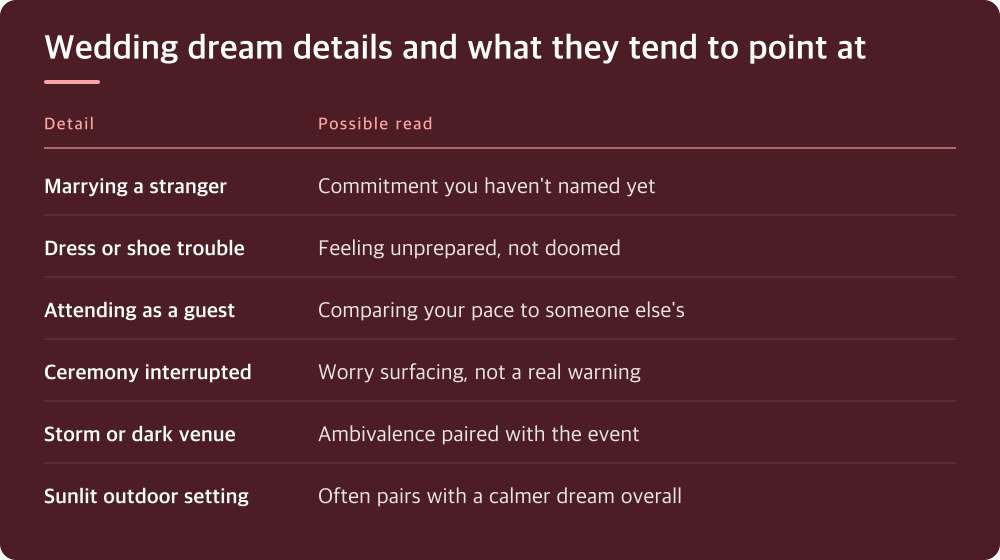
If the person was a stranger, that’s worth noting rather than dismissing. A faceless or unknown groom or bride can point to a decision you’re circling but haven’t named yet — you know you’re committing to something, you just haven’t put a label on what. If the person was someone you have real unresolved feelings about, the dream may be doing something closer to processing than predicting: turning over old attachment, not foretelling a reunion.
How you felt standing at the altar matters more than who stood next to you. Calm and settled reads very differently from a dream where you’re frozen, can’t speak, or feel like you’re watching yourself from outside your body. The second version usually tracks with ambivalence about a commitment you’re already inside of, not a warning about a future one.
Dress trouble and venue chaos usually point at pressure, not fate
A common version of this dream: you’re getting married and the dress doesn’t fit, or it’s the wrong dress, or you’re missing a shoe and the ceremony is about to start. This is one of the more straightforward dream patterns — it tends to track with feeling unprepared for something, not with the wedding itself going wrong in any symbolic sense. The dress is standing in for ‘am I ready,’ and the fit problem is the anxiety made literal.
Venue chaos — the wrong building, no chairs set up, the officiant missing — often shows up when you’re being asked to perform a role (a promotion, a move, stepping into a relationship that’s getting more serious) before you feel equipped for it. The dream isn’t telling you the thing will fail. It’s showing you where the pressure is sitting.
If the chaos dream recurs on nights before something specific — a big meeting, a deadline, a first date with someone new — that’s a pattern worth noticing on its own, separate from the wedding symbolism. Recurring pre-event anxiety dreams are common and usually settle once the actual event passes, but if they’re disrupting your sleep on a regular basis beyond that, a doctor or sleep specialist is a better resource than any dream dictionary.
Attending someone else’s wedding changes the whole reading
Dreaming that you’re a guest rather than the one getting married shifts the focus almost entirely. You’re watching a commitment happen rather than making one, which often lines up with watching someone else’s life move forward — a friend getting engaged, a sibling buying a house, a peer landing the job you wanted — while you feel static by comparison. The dream isn’t jealousy dressed up, necessarily, but it can be your mind flagging a comparison you’ve been making while awake without quite admitting it.
Pay attention to your role at the wedding. Giving a toast, being asked to help with something, standing in the wedding party — these put you inside the event even though it’s not your commitment, which can point to feeling responsible for or entangled in someone else’s big decision. Sitting in the back row, missing the ceremony, or arriving late tends to track more with feeling left out of a milestone than with any particular opinion about the couple.
If the dream wedding involved real people in your life and left you with a strong emotional residue — resentment, grief, longing — that residue is the data point, not the dream’s plot. Ask what in your waking relationship with that person already carries that feeling. The dream didn’t create it; it surfaced it.
A wedding that goes wrong is not a warning about your actual relationship
Objects breaking, rings dropped, vows forgotten, the ceremony interrupted — these dreams can feel ominous, especially if you are actually planning a wedding or in a serious relationship. It’s worth saying directly: there’s no credible basis for reading a dream like this as a prediction about your real relationship ending or struggling. Dreams reflect what’s active in your mind, not what’s coming.
What these dreams more plausibly reflect is wherever your attention has been sitting — if you’ve been low-grade worried about commitment, financial strain, family opinions about the relationship, or your own readiness, a disrupted-wedding dream can be your mind replaying that worry in a more dramatic shape. The interruption is often a stand-in for whatever is interrupting your peace of mind while awake, which may have nothing to do with the relationship itself.
If you notice this type of dream recurring alongside real anxiety, intrusive worry, or sleep that doesn’t feel restful, that’s a signal to talk to a doctor or a licensed therapist, not to over-interpret the dream further. Recurring distressing dreams tied to ongoing anxiety are a sleep and mental health matter first, a symbolism matter second.
The setting and the weather are doing more work than you think
An outdoor wedding in bright sun reads differently than one in a dim hall or during a storm, and it’s worth separating the setting from the event. A sunny, open setting often shows up alongside dreams that otherwise feel settled — the commitment-adjacent themes with none of the anxiety. A cramped, dark, or storm-interrupted setting tends to pair with the chaos and ambivalence versions of this dream, reinforcing the same read rather than adding a new one.
Old or decaying venues — a crumbling church, an abandoned hall dressed up for the occasion — sometimes show up when the ‘commitment’ in question is to something that already feels past its useful life: a job you’ve outgrown, a friendship running on habit, a version of a relationship that used to fit and doesn’t now. The wedding imagery is borrowing the shape of commitment to talk about something that needs ending, not starting.
None of this is a fixed dictionary. The same storm-at-the-wedding image will mean something different to someone mid-divorce than to someone who just got engaged, because the dream is built from whatever is already loaded into your head. Read the setting against your actual week, not against a universal key.
What to actually do with a dream like this
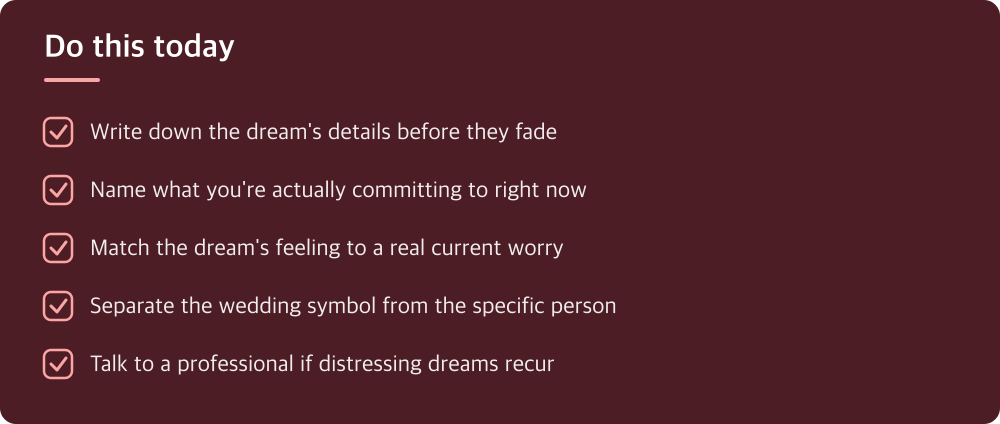
Start by writing down what you remember before it fades — who was there, how you felt, what went wrong or didn’t, what the setting looked like. The specific details matter more than the general ‘I dreamed about a wedding’ summary, and they fade fast once you’re up and moving.
Then look at what’s actually active in your life right now: a decision you’re circling, a comparison you’ve been making, a commitment you’re inside of and unsure about. Match the dream’s emotional tone — calm, frantic, embarrassed, relieved — to whatever in your waking life carries that same tone. That match is a more reliable guide than any symbol list, including this one.
If the dream keeps recurring, or it’s leaving you anxious or exhausted during the day, that’s worth mentioning to a doctor or licensed therapist rather than solving through interpretation alone. One dream is a prompt to think something over. A pattern of distressing dreams is a different category of problem and deserves a different kind of attention.
Do this today
- Write down the dream’s details before they fade
- Name what you’re actually committing to right now
- Match the dream’s feeling to a real current worry
- Separate the wedding symbol from the specific person
- Talk to a professional if distressing dreams recur
※ This is informational and not a recommendation of any specific product or company.
1 thought on “You Dreamed of a Wedding and You’re Not Even Dating Anyone: What That Might Mean”